
Mike Vaccaro is optimistic. He’s very grateful for his opportunities. He says that if you love what you do, you’ll never work a day in your life.
Since he got out of college, Vaccaro has never worked a day.
For 23 years, he’s been the lead sports columnist for the New York Post. That is a job he says he wanted since he was 7, growing up on Long Island. He remembers how his father hated his daily routine “in a mind-numbing office job, but it paid the rent and covered (Mike Vaccaro’s) tuition and put food on the table.”
What his dad loved was playing trumpet on the weekends. “He came home with a smile on his face, every time,” Vaccaro said.
In a journalistic sense, all week long, Vaccaro plays trumpet.
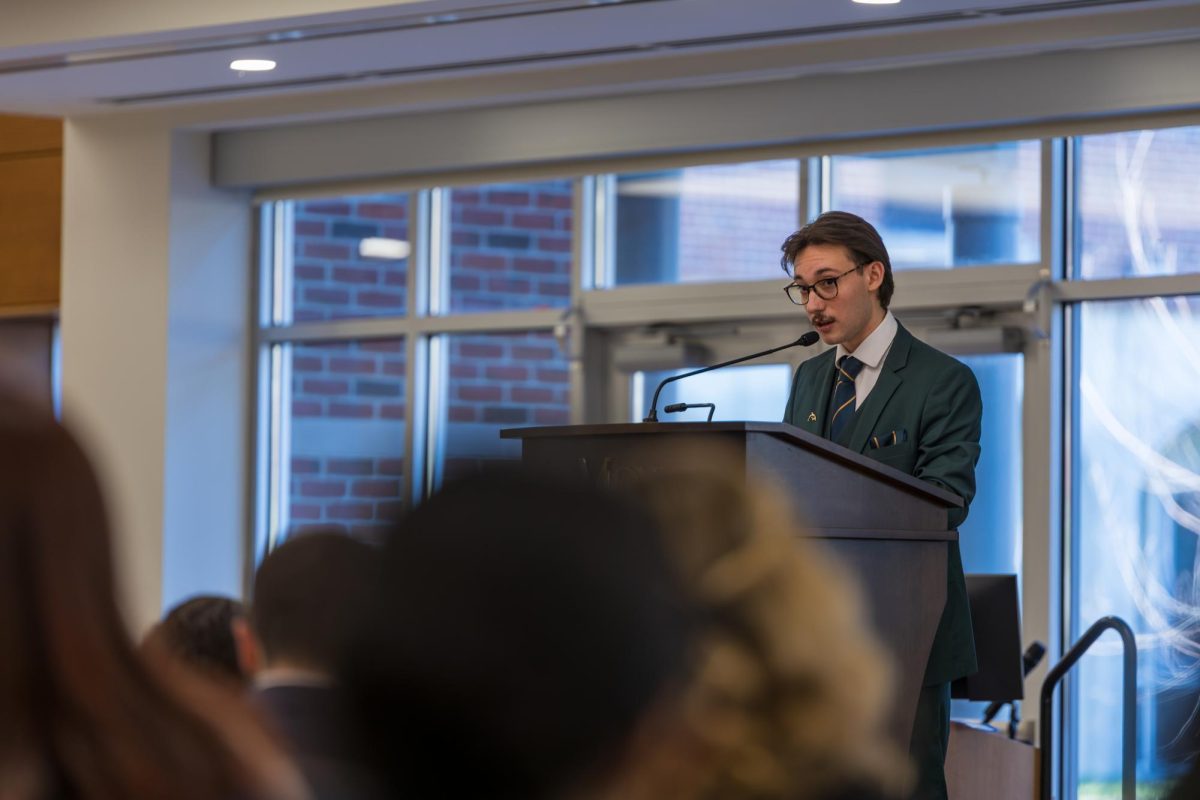
Last week, Vaccaro, a St. Bonaventure graduate, took time out of his busy schedule – he will write as many as four or five sports columns a week – to pay a visit via Zoom with a Le Moyne sports journalism class, in Reilly Hall. Throughout the conversation, Vaccaro offered many insights into the craft of column writing about sports.
“If you’re writing an opinion, it better not be a dumb one,” Vaccaro says – insisting the mission for a columnist is to stay informed and to “be informative.”
In a world gone digital where print newspapers are dying, Vaccaro arrived with a surprising message: “There’s more good sportswriting today than ever before,” he said.
Of sportswriting, he told a roomful of young potential journalists: “It’s an extraordinary way to make a living.”
In some ways, he said, sports journalism jobs are more accessible than ever.
There are a lot more outlets now than 20 years ago, Vaccaro said, because of technology. He is certainly aware that many observers claim journalism is a bleak field for young people to pursue.
With passion, he disagrees. He said his own experience makes him optimistic. “It wasn’t easy for me, but I got this job at 35,” he said. Vaccaro’s advice to up-and-coming journalists is simple:
“The only person that will care as fervently about your career is you.”
What that means, he said, is that – once you’re out of college – you’ve got to do the hard dirty work to succeed in the business. By that, he means you might need to work long hours for low pay in a faraway place to prove yourself.
“I would never be where I am if I didn’t go to Arkansas,” Vaccaro said of a job that was a learning experience at the start of his career.
Along the way, he’s collected many unforgettable experiences with sports legends. Muhammad Ali performed magic tricks for him at a New York City steakhouse. Michael Jordan casually shot crumpled balls of notebook paper into a trash can during an interview.
These moments, now increasingly rare in an era where casual one-on-one interactions with stars have all but disappeared, remind him of why he fell in with the profession.
Vaccaro also spoke of the power of writing about personal aspects of your life – as long as you do it sparingly, which makes it more effective. That’s exactly what Vaccaro did in a column about the amputation of his leg, below the knee. He said he wanted to write that “on my own, in my own context.”
He knew people would hear about his surgery, and he wanted control of how the story was delivered.
The response was overwhelming and positive.
There was a similar reaction from readers to his column after the terrorist attacks of Sept. 11, 2001. He went to a park in Hoboken on the night after the attacks, where he could see the New York City skyline without the World Trade Center before the sun came up on Sept. 12.
The piece was so important to him that he reposts it every year, on the anniversary of the attacks.
“You’re not always writing about the sunny side,” he said. “Sometimes you write about the dark side.”
The critical element with column writing, he said, is finding your own voice. “Columns make readers feel something,” he said, and “they can make you laugh once in a while, make you cry once in a while and even make you angry.”
For all the heated division in the world, Vaccaro has what might seem like a counterintuitive belief: “At heart, most people are nice.” Throughout the conversation – and his career – he expressed one clear motivation:
“You have the power to tell a story (and) even if it only reaches one person, you’ll write something that matters to somebody.”
This article was written by: Hope Adigun, Scott Borden, Riley Brennen, Lilly Capria, Samantha
Carroll, Ashley Carter, Grace Crooks, Adrianna Exarchakis, Catherine Kidby, Dave Kleberg, Nathaniel
Kwait, Nicholas Lauro, Branwyn Lupton, Sophia Melone, Olivia Metcalf, McKenzie Ponto, Simone
Schwarz-Eise, Mack Suleiman, Marialicia Vick