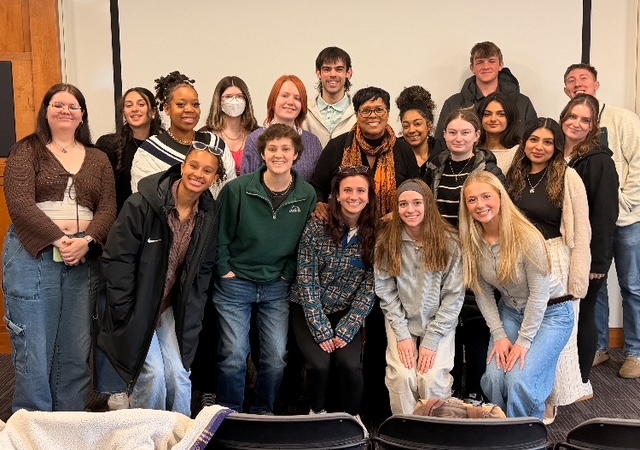

Sharon Owens, mayor of Syracuse, held a news conference last month at Le Moyne College with a class of student journalists. Owens, the first Black mayor and second female mayor of the city, won as a Democrat this past November with over 70% of the vote.
Students had the chance to individually ask her questions about herself and her first 100 days in office. Questions ranged from construction on I-81 to how her day was going.
On top of this, Owens encouraged students to get off campus and immerse themselves in the Syracuse community. She shared that when she was in college, she initially anticipated working in the field of economics before landing an internship with the Dunbar Center on the South Side of Syracuse.
“It changed the trajectory of my life,” she said. “I got an opportunity to meet the kids and the families on the South Side, and knew that community work was what I wanted to do.”
Her care for the citizens of Syracuse has persisted not only through her hundred days, she said, but through the past eight years as deputy mayor under the administration of Ben Walsh, a political independent. Based on her response to students’ questions, she clearly showed one of her main concerns is the housing crisis, which has been a focus of hers for much of her career.
While talking about the effects of student housing on the city budget and surrounding neighborhoods, she also emphasized the importance of having affordable housing with more bedrooms to accommodate families in need, especially with the ongoing development of Micron in the area.
This conference created a unique opportunity for students to open up a discussion of topics with an important government leader about their experiences in the Syracuse area. Students transcribed their questions and her answers.
A complete transcript – lightly edited for space – follows, with the names of student-journalists listed, before their questions:
Maya Carpenter: How do you manage Syracuse growth from projects like I-81 and Micron while making sure current residents, students and longtime community members aren’t pushed out by rising costs and housing issues?
Mayor Owens: So one of the things that I found when I graduated from SU in ’85 … most of the peers that I had were the children of folks in this community who worked at New Process Gear, the Miller Brewery, GE all of those companies that really afforded those families to have a very strong middle class living, particularly for people of color
Those jobs started outsourcing and moving out, so people had to make a decision: Either they’re going to follow the job and leave or they were going to stay here because this is where the roots were and take a job that was definitely under their skill set and absolutely less than what they were making. We cannot make that mistake again.
One of the things I’m the proudest about, particularly during the Walsh administration, was work force development and workforce initiatives. One shift we made is that we were training people on basic skills [and] we were seeing people with a folder full of certificates of completion and no job. And I said, we’re not going to do that anymore. We’re going to train to the industry.
The first industry that we modeled that after was what was going to be done with the 81 viaduct. You guys know the story … Fifteenth Ward. Large black community, large Jewish community … that neighborhood decimated by the interstate highway development. We hear stories from people that they actually knew that they had to move because they went back home and saw a red X on their door.
There was no community engagement. There was no advocacy protections back then. Thank God, they have been embedded now. So what we did: We began to train under an initiative called Syracuse Build ‘Pathways to Apprenticeship.’ The 81 project has a public labor agreement. We have unions working with us to train the workers on that job. It is becoming a game changer for people. We want individuals who grew up and lived in the zip codes that were decimated by the building of that highway and now are part of reconfiguring that highway and taking it down.
That is what job creation and job training should be about, changing the trajectory of the lives of individuals and their families. So that’s how we ensure that we don’t make the same mistake when those other factories started closing down and there was no plan for people.
Now the new industry is semiconductors. So with the Micron moment, we are building the on-ramp … The old Sears building on South Salina Street that has been vacant as long as I’ve been in Syracuse, we now have $80 million to reconfigure that and reconstruct that, not just for the building, for the training, but also it’s going to be a campus for work and play space along that Salina Street corridor. Now, property owners around it are coming to my office to meet with me because we’re investing in it now, in that area.
Another priority is to be sure we don’t price people out of housing. There’s one thing: He who owns the land really controls the narrative when it comes to development. And that includes housing. And so I’m very proud that Syracuse has probably the only inclusive zoning law in all of Onondaga County and much of Central New York that allows for affordable housing to happen in the city.
Mairead Conway: To kind of piggyback off of what you mentioned earlier about your work at many community agencies and organizations: How is that going to guide you in your role mayor?
Mayor Owens: Everything that I do now is focused in on the decisions we’re making as it was in the jobs before: Why are we doing it? How is it going to affect the lives of people? Is it going to affect the lives of people in a positive way?
I mean, even down to when we rolled out our trash can program, right? And we had to really think through how there are seniors who can’t manage a 90-gallon can. So we had to make modifications to that. I mean, we rolled out our speed zone, school speed zones and we really looked at possibly rolling it out citywide.
And then we began to think about, is that going to cause some disparities in different neighborhoods? We settled on just doing the school zones, the traffic where our schools are. And so we still get people disputing. We clocked somebody on Geddes Street, 75 miles an hour, who had the nerve to come in and want to argue about that.
For those of you who don’t know, Syracuse, Buffalo and Rochester are all between one and 10 in the entire nation of cities with the most poverty children in poverty that are black and brown. It is unacceptable all along that I-90 corridor.
Until we do things economically that increase the amount of money coming into people’s households, we’re just blowing smoke. What we are doing is addressing the residual effects of poverty, poor housing choices, poor food choices, poor health, limited health options. And we should be addressing those things.
But to address poverty, you’ve got to get money into the hands of people where they live. I’m a Black woman. I experienced life in the United States as a Black woman. Ben Walsh [the former mayor of Syracuse] was my colleague. We worked well together. He’s a 40-something-year-old white man. I’m a 62-year-old Black woman. So my experience and my perspective about life in this country, life in this state, life in Syracuse … [it’s] very different. And everything that I do is really thinking and focusing on: How is the decision I’m making in City Hall affecting the people who live in this city?
Hannah Jimenez: As you pass your first 100 days in office, how have the realities of governing shaped or changed your campaign priorities? And when you look back years from now, what specific changes do you hope residents will point out?
Mayor Owens: So my mantra to my staff is: Get stuff done, using a different word. We’re a Bloomberg city, so we’ve been going through the Bloomberg cohorts about using data to make informed decisions about policy and what we do in the city of Syracuse. I have really come to embrace and understand that data is important because you need to make decisions based on data, not based on who has your phone number or who has the right cell phone number or who hangs out in the right places, with decision makers. That is not an equitable way of governing.
But if you have data about the condition of roads or data about the condition of housing, then you’re making informed decisions based on that data and not just by who knows who. That’s why I said: Get stuff done. We have many projects we were doing in the previous administration and I see my administration as not starting from day one. I think the people appreciate the continuity that we have moving from the Walsh administration to mine.
I want to see projects, housing, created. I want to see that 81 project done by the time I’m done with the first term or close to that. Those things are important to me to ensure that people can touch and feel change.
Syracuse has to be a vibrant city. So I want to turn on the lights in dark spaces. Our downtown is thriving, but I call downtown the beating heart. Leading into that beating heart are what I call our neighborhood and commercial corridors. Erie Boulevard is a target for me because Erie Boulevard drives me crazy … say, between Teall and Thompson. I mean, once you pass Thompson Road, it’s like the sky opens up and butterflies start flying. But before that, it’s all gated up, it’s all closed, it’s all it’s just junky. And so to my chief strategy officer, also the economic guru, I said: ‘Erie Boulevard. That’s a focus for you.’
The other focus for me is the Inner Harbor. It’s our new neighborhood. It’s our new opportunity. It’s a blank slate. … we need to build around the Inner Harbor. Everybody knows the aquarium is going to be out there. Love it, hate it … this is how I feel about the aquarium: Could, originally, $85 million have been used for all this housing we need? Absolutely.
But every time I drive by there, that thing is bigger and longer. And so it’s there. So now I’m focused in on: How are we going to develop around it. Who’s going to be working there? Are they going to have a living wage job? And how can our kids really take advantage of that experience? … [How do we] get corporate sponsors for free tickets for our kids to really take advantage of that?
So I want to see this development happening, and I want to ensure that people can see the change and the shift in our city … and that’s why I’m going to be hiring a nightlife coordinator and that person’s job is really taking a look at the spaces and places in Syracuse because not everybody wants to be in a bar with alcohol.
Now, my parents [one of] their businesses was a bar. So I don’t have anything against bars, but everybody doesn’t want to or shouldn’t be in a bar setting. So what are the other options? My daughter is a spoken word artist. They want to have different spaces. I just went to a young professional networking opportunity downtown… it was amazing. You know, just different kind of venues.
The arts are huge to me … it’s a lot. Yeah, I’ve got a big agenda.
Hope Adigun: I have two questions. My first one you might not be able to answer, but there’s kind of been a little bit of a complaint for athletes who play fall or spring sports because we’re not allowed to get lights on our fields. So I was wondering if that’s something you can address since everyone’s been saying it’s a town of DeWitt issue.
Mayor Owens: I’ll give you a couple of names you guys can talk to on that on that town board: Bishop Bernard Alex, he’s on that town board. And Dr. Indu Gupta is on that town board. So it could be a compromise of when the lights are on and when they turn off.
Hope: My real question, going back to the topic of housing, are there plans to expand or regulate student housing to ease pressure on local neighborhoods?
Mayor Owens: So your president is a good friend of mine. She’s an amazing person. But I get complaints from neighbors right over there because when we were walking around and I’m shaking hands and knocking on doors, neighbors are saying houses that used to be owned by single families are now student occupied and – not you guys – but some students are not good neighbors.
So this is becoming kind of an issue around here because your campus is expanding, your college is growing as it should, because you provide an amazing education. But the neighbors … are starting to say, wait a minute: Too many properties are being acquired by a private entity and it’s being turned into student housing. This is an issue on [the SU campus] and the neighborhoods around it … And I’ve been a proponent. It’s like, build, just build on your campus.
So as this campus housing expands, we get some push and pull from neighbors … [And] sometimes there’s a conversation around: Well, we bought a house and it’s student housing. No, you bought a house and students lived there. It is going to be taxed.
So here I am as a mayor, really looking at property tax revenue to help me fund police and fire and DPW to get you plowed out. Less than half of those properties actually contribute to the tax base. That is always a dilemma.
Lanie Smith: Since being in office, how prevalent have conflicts regarding the presence of ICE been, and what limitations do you face in trying to combat these conflicts? Are there other issues regarding Ice you anticipate down the road, or that have been challenging to address?
Mayor Owens: … What we have said in the city of Syracuse is that the police department and the officers of the police department do not act as ICE agents. We do not enforce ICE policies. It will be interesting for you all to know that when ICE is in town, City Hall nor the police department is notified. We find out because constituents call us and let us know.
I have a couple meetings with a couple of community groups later this month to talk about that a little bit more as they organize a little bit more to protect folks. Our police are enforcing laws and detaining people who violate laws. The sheriff’s office actually manages the jails. So this is really where ICE has been trying to really insert itself, while people are being detained in the jails, to have access to jails, to remove people, to put them in detention centers.
Onondaga County Sheriff Toby Shelley has said that he is not going to detain people for the purpose of ICE. So God forbid you’ll never be arrested. But if you’re arrested and you’re placed in an Onondaga County jail, which is downtown or at Jamesville, you will be there for the term determined by a court.
First of all, there is no human being on the face of the earth that’s illegal. Doesn’t exist… Our sheriff has said he’s not going to remove prisoners based on immigration status. There are other sheriffs who absolutely do … There are some counties that have entered into this agreement that basically deputizes their law enforcement to serve in this capacity as implementing the activities of ICE.
Onondaga County and the Syracuse Police Department definitely are not in one of those agreements. What this law [proposed by Gov. Kathy Hochul] is going to do is forbid that in New York State, and I believe that it’s going to pass.
We have 82 languages in our school district because we have so many people from different communities and different countries who have come here and call Syracuse home. Every one of them is precious. And I have declared repeatedly the role of our police department will not be serving as ICE agents.
And I had the opportunity to appoint a a new member to the school board. [He] is a new American [who] grew up in a refugee resettlement camp. And so we are so happy to have him on the school board to represent all of those new American families who had no representation on the board.
Munenyasha Siguake: As the first African-American mayor and the second woman to serve as mayor, how do you see your leadership helping create a more inclusive and equitable future for Syracuse?
Mayor Owens: Well, I mean, it starts with me being who I am. Even as deputy mayor, I remember people asking me, what does it mean for you to [serve in that role]? And I said, what’s important for me, being deputy mayor, is for other people seeing themselves as [having] the potential of being deputy mayor.
Being mayor, to me, gives the potential [that’s always there] when you’re the first, because you are breaking a ceiling or kicking down a door toward what people thought could never happen. The fact that 81 was built and decimated the Black community, the redlining that happened in this community, the long history of policy making that really worked against, particularly, communities of color. So there are people in their 70s here who walk up to me now and say to me: I never thought that I would see this in Syracuse, and here I am.
What that means to me is that it is a huge responsibility to me to be … as my mother would always say, you’re just not representing you, you’re representing your family. And so I’m representing the legacy of elders in this community who for decades have waited for this day. That is my calling and my responsibility.
Nick Lauro: How do you handle the criticism – or find support – regarding all the highway traffic affected by construction on 690 and 81?
Mayor Owens: First of all, I say: It’s not my project [the job is coordinated by the state with primarily federal funding]. But we work together. I have a regular meeting with the [state] DOT every month [and] we’re on the phone with the DOT every day. Like what’s going on up right now [an 81 tie-up] is not good. We’re working with them to talk about it.
I think, you know, everybody here, we believe we can get anywhere in 10 minutes. Doesn’t matter [where]. You can get there in 10 minutes. This is something burned into our minds. And a friend said to me, I’m, trying to get somewhere. [And] I’m like, oh, there’s traffic. And he was like, Sharon, you are paused in progress.
We are not used to this. We haven’t seen this many cranes in our community in decades. It is a sign of growth. I’m looking forward to every aspect of it, taking down [ramps toward] 690, taking down 81. And I’m just asking people to put a seatbelt on, literally and figuratively on, and just bear it until we get through it.
So I tell people, listen, take out your phones: [Get] the 81 app, you get alerts. When the pattern changes, I get an alert. Take another route because this is happening. It’s not the answer people want to hear, but it’s going to be all the better for the city when those highways come down. And so I’m grinning and bearing it through it.
Emily Symans: It is great to see that Dr. Linda LeMura, president of Le Moyne College, served as a co-chair of your transition team. Can you tell us some of the areas where you see potential collaboration between your and the college going forward?
Mayor Owens: I had a meeting right at the new coffee shop over there with the [new] superintendent and your president about really how Le Moyne can play a role in equipping the [school district] staff, recruitment for staff and educational opportunities for the students there.
We [are] pushing for some of you all who are studying education to go into the school district’s classrooms to help. So I’m a conduit to those conversations. I know your president very well and know the superintendent very well and where we can make that happen, I’m all for it.
Mandy Condes: In recent years, attacks at Pride events during June have spiked, causing concerns for those who celebrate at public events. What measures are you taking as mayor to ensure the safety of participants of CNY Pride Fest at the Inner-Harbor?
Mayor Owens: So we mobilize in a big way down there … it is a horrible statement of where we are as a country. We’ve seen some tragedies in different festivals … so we put out barricades, the big concrete things, to ensure that cars can’t get through. We just had a No Kings rally over there on Solar Street, two idiots in a truck tried to come into [it]. I have no tolerance for people who think that their views are better than anyone’s views, and that they can interfere in how people work.
I’m going to be at the Pride Festival. I’ve been at every single one of them. I’m going to be at the flag raising. We mobilized quite a few of our police for that parade and the activities in the Inner Harbor, and we’re looking forward to it.
Catherine Kidby: You brought up earlier how your experience in America [was shaped] by being a 62-year-old Black woman. I was wondering if you could elaborate on that experience, being in America and running for a government position as it relates to race, gender, or age discrimination. And also, if you have any advice for someone who’s in a similar position wanting to work in government positions?
Mayor Owens: So there were a couple of things for me, running for mayor. It was the first time I ever ran for anything. I’m told I’m a politician because I’m mayor, but I can’t stand politics. For me, it’s about service. And we’re all, every one of us that are elected, public servants
And so, me supporting Ben Walsh as an independent when I’ve been a lifelong Democrat made trouble for me amongst Democrats in our community, particularly in the local organized committee. So when I decided to run, I didn’t get [that] support, but I lived a life where I never could wait on people to support me. I had to step out and do it on my own. And there were plenty of people who also said, yeah, you know, okay, they don’t want to support you, that’s fine.
I’ve been a Democrat my whole life [but] I vote for people who I think are going to work for people. And so I felt like [Walsh] was an independent, but I felt I worked well with him. I knew who he was as a human being, and that’s who I was supporting. And I didn’t care what anybody thought.
When it came time for me to run, I ran into walls with people. People are coming around now because I won. Now they want my opinion. They’re like, can you support this person? I’m like, what are those candidates talking about? What do you stand for? What do you believe?
My mother’s always in my head, you know, always: Have your stuff together, Sharon. But I can only be me. And me is based on perspectives that I’ve had being on this Earth for 62 years and being Black all 62 years of my life.
Listen, is there racism in this country? You’re damn right there is. Are there bigoted policies and methodologies in this country? Absolutely. Homophobic? You better believe it. Misogynist? Hell yeah. And so, that perspective really gels in the beef stew of who I am as I’m thinking about what we’re going to do.
And the thing is: [You] have your belief, but don’t think your belief is any better than mine. And so if you are looking whether it is public service or politics … just stand on what you believe and I guarantee you there are going to be other people that stand there with you. You just might not be part of the establishment, but [what] we’re proving … the county Democrats flipped the county [legislature] … people with like minds … came together to do that.
Stand on what you believe. Stand on who you are … I could waver here and there depending on who likes what I said or didn’t like what I say. Even if I change direction to go with the way they like it, it’ll be the next day and they’re mad at me about something else. So I’d rather you be mad at me for what I’m going to stand for, what I think is right … and what I think is right is that people should be able to live in respect and humanity and safety every day of their lives.
Abby Files: What role do you think young people – and college students in particular – should play in shaping Syracuse’s future?
Mayor Owens: Oh my goodness. First of all, I love Le Moyne. The fact that most of you, a lot of you, are from this community, I love it. [Still]: Get off the campus. Best thing I did as an undergrad at SU was to get off that hill. Everything that you’re learning academically makes you a more well-rounded person when you’re able to apply [it] to the reality we’re facing in this community, whether it is poverty or economic development or housing or education.
And there are so many volunteer opportunities off of this campus that you should take advantage of. One of the best portals to find those opportunities is through the United Way. On their website, you can [see] where you can volunteer and help out with hunger in this community, homelessness in this community… Get off the campus.
Joe Calveric: I recently [saw] the Syracuse.com article about some local convenience stores that were shut down for illegal activity. As someone who’s lived here my whole life, I’m very familiar with how some convenience stores are selling marijuana to people who are underage. What is the primary concern with shutting these down?
Mayor Owens: I am not anti-business. I am anti-bad business and I call bad business any business that infringes upon the health and safety and welfare of a neighborhood. So, I understand we have food deserts all over this community … [and] we are finally going to get another grocery store in the Valley area of the city.
But because there are food deserts and they aren’t walkable, people are subjected to going to what they can walk to … What I have a problem with is I go to Costco’s and I see the same milk that cost me $3 there, you’re selling it for $5 in the [corner] store. No, that’s not okay.
And it’s not just the marijuana. Marijuana is legal, but you have to have it in a legal establishment. It is the synthetic drugs that they’re selling in there. We had a bad batch of something out right now that people are really OD’ing on right now … I saw a picture of synthetic marijuana in a paint bucket in one of these stores [where] we got a picture.
I understand that shutting them down is not the long-term fix, but I need [them] replaced with something that is going to give us some wholesome food and a in a safe environment. The other thing that is my nemesis right now is that the drugstore industry began to build exponentially, whether it was Rite Aid’s or Walgreens in our community.
And then they began to downsize. And now our city is stuck with all these vacant drugstores all over the city that the owners want to sell for exorbitant prices. And I’m really exploring what are my options to seize them, get control of them, and repurpose them for the public good.
Mia Lesley-Fox: Syracuse’s public transportation system is rather limited. Do you have plans to improve public transportation within the city?
Mayor Owens: I’m looking forward to Centro, which is our regional transportation authority, implementing the bus rapid transit. There’s a BRT system in Albany. It’s a much bigger bus with very streamlined routes. So there are two routes they’re looking at now. One is from Western Lights through Syracuse to all the way to the top of James Street, where Thompson Road is. The other one is from Shop City all the way down North Salina to the Valley.
The best thing about these buses for me in the city is that Centro will be improving the infrastructure. So while you’re waiting for a bus, your phone will offer interactive opportunities. The other thing is that Micron is actually purchasing from Centro a bus route that will go directly … to where their fabs are going to be, because you’ve got to get people out to where the jobs are.
I believe that all of the construction going on with the I-81 project is also going to streamline our ability [and] I’m hiring … one of our vacant positions in our Department of Public Works … I’m going to hire for a position that I’m calling a transportation and mobility commissioner, and that person’s job will be to look at how we move in Syracuse, whether it be car, bus, bike, motorbike, walking … and so that person’s job will really look at how we’ll be able to move around Syracuse as we change.
Sophia Morphet: As a longtime resident of the greater Syracuse area, I frequently heard the argument that Syracuse University doesn’t give back what it should be giving to the community, whether that’s through property taxes or community engagement with the rest of the city. What would you want to see from them to change this, and what can other local schools do to become pillars of the Syracuse community?
Mayor Owens: This question got me in trouble a couple of weeks ago. So let me start by saying, [Syracuse University] … has an agreement with us, they pay us $2.5 million over the course of five years. People will say that’s a drop in the bucket for the services that [we] provide [though] they also pay overtime details … when you see Syracuse police out there for dome activities, they [SU officials] are paying for the overtime for those officers to be there.
Whether it’s Syracuse University, Le Moyne, our hospitals, they are are huge economic drivers. They employ a lot of people in our community, which is really important to us. The agreement that we have at SU, I would love to see a similar agreement with these other large not-for-profits to help us in financing many of the services that they need: Police, fire, DPW.
We’re in the middle of our budgeting process now. I’ve presented a budget to the Common Council … and they’re reviewing it now. It costs millions of dollars to run a city. And I have a tax base that contributes to that, [a tax base], as I mentioned, [that] is less than half of that. SU does have an agreement with us. We’re entering into discussions to renew that agreement.
But I also want to talk to President LeMura; I mean, half of your campus is in the city of Syracuse, and some of that [compensation for services] could be in cash payments, but it also could be in amenities … free tuition or other amenities that a university, a hospital can provide to the city to level the playing field when it comes to the compensation we get.
Riley Brennen: How do you and your team stay so positive despite all the stresses that you face?
Mayor Owens: One thing … 2020 was very hard. People were dying [from Covid-19]. It was a stressful, stressful time and not only for the worldwide pandemic, but also it was during the time of the social justice protests for the murder of George Floyd. One thing that was really difficult for me [during] the social justice protests was I had worked in the community for over 30 years, and then I had gone to work for government again two years before that.
And many of the people that were protesting were people that I was having meetings with [earlier] around inequity and social justice issues. And then when I went into City Hall, all of a sudden it was like: You’re the enemy. And that really began to like hit home [and] was a difficult time for me. It really caused me to question whether I wanted to do what I was doing at the time, and I was able to work through it.
I keep a circle of close friends around me. That helped me through the times that you’re talking about now. At this point in my life … Look, I’m 62. It’s what it is as far as I’m concerned; I’m going to be who I’m going to be. And I’ve really come to an understanding [of what most people want]:
Keep me safe. Pick up my trash. Plow my street. If you can handle those three things, I’m okay. And when the snow melts, please stop me from flooding. Right? So I’ve come to a place where it was very important for me to bring folks around me to have that same kind of approach, that understanding that what we do … we signed up for it and we’re public servants and as nasty as some of that public can be, I’m still here to serve them.
Michelle Hiney: I know you talked about the aquarium earlier. How do you plan to respond to people’s concerns about transparency [in financing the aquarium]?
Mayor Owens: Transparency is a responsibility of government. I just feel with that aquarium: Listen, it’s not like we can like stop the building of the thing and then reverse course because at one point, people were suggesting redevelopment. Redevelopment for housing. That’s not how it works. It was designed with huge tanks in it to fit sharks and stingray and that type of thing, so it’s going to be what it is at this point.
Just say what the heck the thing is going to cost and let’s pay for it and get it open so we can start doing some of the things that it’s been promised it’s going to do. Transparency is huge. It’s. We’re in a state in this country because of not being transparent about things that put us in a war. Nobody really understands why we’re in it, right? It’s not an option. It’s a responsibility to be transparent.
And so just say … if it costs $150 million, just say it’s going to cost $150 million. And let’s just figure it out at this point. What else are we going to do with it? Let’s just get it done and get the thing open so you guys can go to it and I can go to it and people can work in it.
Alia Tennon: You touched a little on the housing crisis. What’s the hardest part about fixing that problem?
Mayor Owens: The biggest problem is our existing housing stock, the average age of our housing stock. I bought my first house, a cute little bungalow in the Valley, and I bought it because I loved the windows and I loved the doors, but there were seven layers of paint on it. And then by the time my son was 2-years-old, I got a letter from Onondaga County that he had been lead poisoned.
Now we’re addressing the EPA mandate for replacement of lead pipes … I’ve been given an estimate for the entire residential job, [and it’s about] $400 million dollars. And so the challenge for us is taking into account: When is it worth the return on investment to invest in the existing house or to tear it down and build new? Because building new, you have no lead in it. It is all environmentally healthy for individuals.
The other crisis we have is that the school district, the superintendent has told me about 10 percent of the kids in the school district are technically defined as homeless. They may not be living under bridges or living outside, as people think unhoused people live, and they may not even necessarily be in a shelter, but they live in hotels.
And so as we see housing development develop, many developers are looking at one and two bedrooms. I need three and four bedrooms. I need larger units. And that is a challenge as everyone is looking at us and saying, ‘We really want to invest in Syracuse.’ And that’s when as the mayor, with my team, are looking at them saying: We’re ready to partner with you, but I don’t need a bunch of one and two bedrooms. I need three and four-bedroom units.
Scott Borden: With all the American sports leagues changing every year and expansion talks happening in the NBA and MLS, I was wondering: Is there was any chance the city of Syracuse would get any of these teams in professional sports?
Mayor Owens: I would love to have[another] professional team here. I’m an athlete. Well, former athlete. I would love to have a [new] professional team here. You know, [there are] a couple of soccer leagues who want to look at us here. We’re the birthplace of lacrosse. I would love a lacrosse league team here. Basketball will be hard because the Orange kind of rule the roost around here, right?
We’re at about 147,000 people. I think we have to get over to that 160, 170 kind of threshold for professional teams to begin to look at us. But we are having conversations. The Inner-Harbor is an amazing opportunity for us to create some new fields out there and look at some potential leagues, but I would love it. Absolutely.